
Role:
UX Designer
Team:
Product, Engineering, Research
Platform:
Internal web application
Timeline:
Multi-quarter initiative
Overview
Customer Service Console (CSC) is Amazon’s internal platform used by customer service associates to handle high-volume customer contacts across chat and phone.
I led the redesign of CSC to reduce agent context switching, enable safe multi-chat handling, and surface critical customer and policy information at the right moment. The goal was to improve response speed and resolution efficiency without compromising customer trust, compliance, or agent experience.
Impact
Enabled up to 3 simultaneous chats per agent
Reduced manual data lookups by 48%
Reduced first response time by 40%
Reduced average contact handling time by 20%
Delivered approximately $2M in annual cost savings
Problem
Customer service associates operate under constant time pressure while resolving complex customer issues. Prior to the redesign, CSC workflows were fragmented and difficult to manage at scale.
Key Challenges
Agents switched between 4 to 6 separate tools during a single contact to access account, order, and policy information.
High-risk customer accounts flagged under Concession Abuse Prevention (CAP) were not consistently surfaced at decision moments.
Post-contact wrap-up was slow and error-prone, impacting reporting accuracy.
The system supported only one active chat at a time, limiting throughput and increasing customer wait times.
These issues increased cognitive load, slowed resolutions, and introduced operational risk.
Constraints and Non-Negotiables
Designing an internal Amazon system required operating within strict constraints:
Core policy logic and backend systems could not be modified.
The solution had to integrate seamlessly with existing internal tools and permissions.
Performance and reliability were critical during peak traffic.
Agents relied heavily on keyboard-first workflows in high-pressure environments.
Accessibility and clarity were required for long shifts.
The design needed to scale across marketplaces, regions, and skill types.
Success Metrics
We aligned design decisions to measurable outcomes from the start.
Primary metrics
First response time
Average Contact Handling Time (AHT)
Multi-chat adoption
CAP compliance signals
Business goals
Improve underwriting efficiency by 20%.
Increase user adoption and trust in AI-generated insights.
Provide transparency and compliance across workflows.
Design goals
Simplify complex data into clear, scannable layouts.
Make AI reasoning visible and easy to understand.
Create a seamless, unified workspace.
Research and Key Insights
I conducted workflow observations, usability testing, and stakeholder interviews with customer service associates, team leads, and operations partners.
Key insights
Agents perform continuous micro-lookups, not a single information check per contact.
Delays in the first 30 seconds of a chat disproportionately impact total handling time.
Risk signals such as CAP flags are only effective when shown at decision points, not buried in separate tools.
Wrap-up is often rushed, requiring guidance that balances speed with accuracy.
Managing multiple chats safely depends on strong visual state awareness and predictable layouts.
These insights directly informed the design strategy
Key Design Decisions
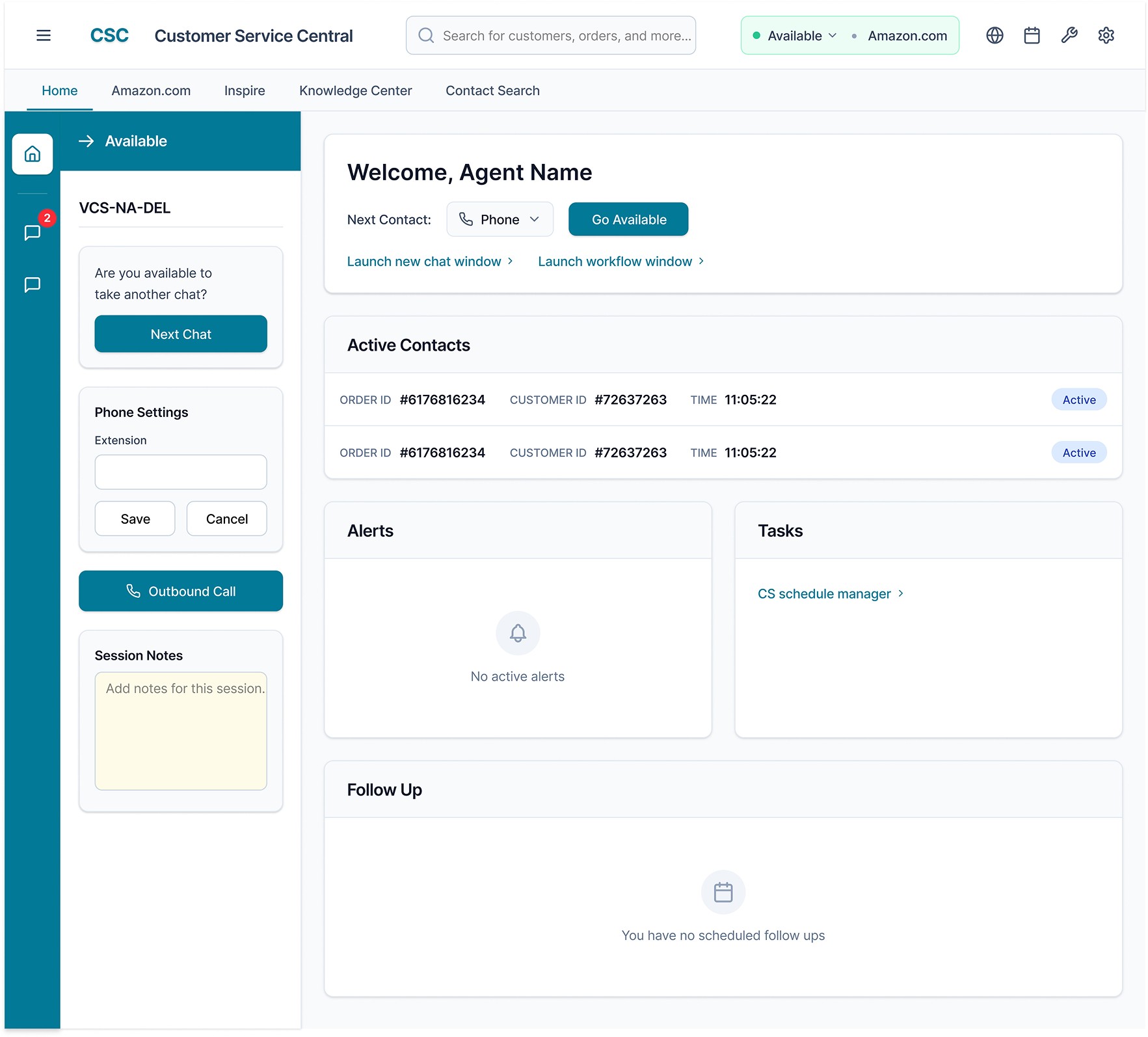
Home screen reimagined
Problem:
Agents lacked a clear starting point, with availability, contacts, and quick actions scattered across the system.
Decision:
Redesigned the home screen into a centralized control center for availability, contacts, and quick actions.
Why it worked:
Centralizing high-frequency actions reduced navigation and improved situational awareness.
Outcome:
Agents managed contacts more efficiently and avoided missed or unresolved cases.
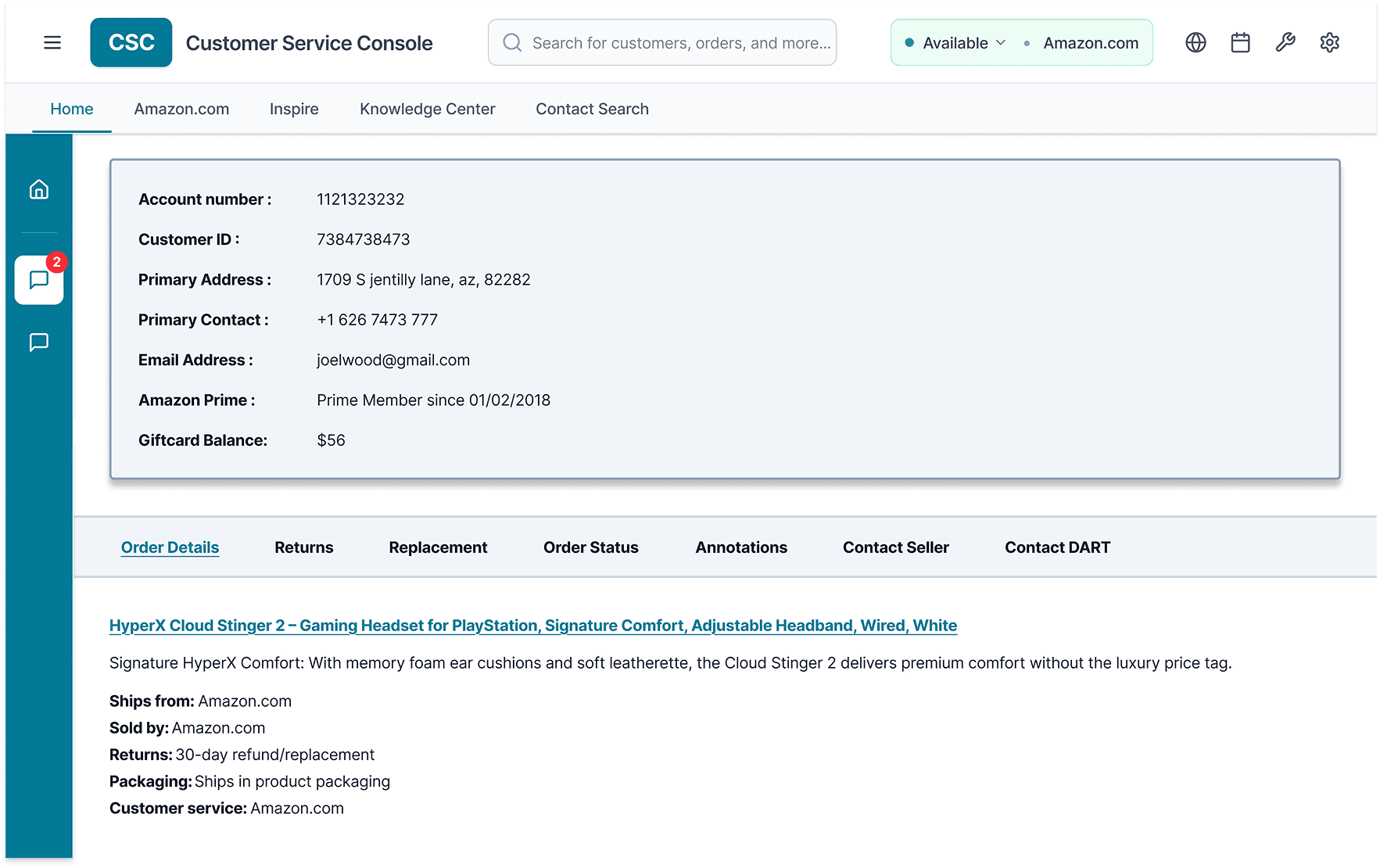
Consolidated Agent Workspace
Problem:
Frequent context switching slowed agents and increased errors.
Decision:
Centralized account, order, and contact information into a single, stable layout.
Why it worked:
Reduced navigation overhead and improved information recall during live contacts.
Outcome:
Manual lookup time reduced by 48%.
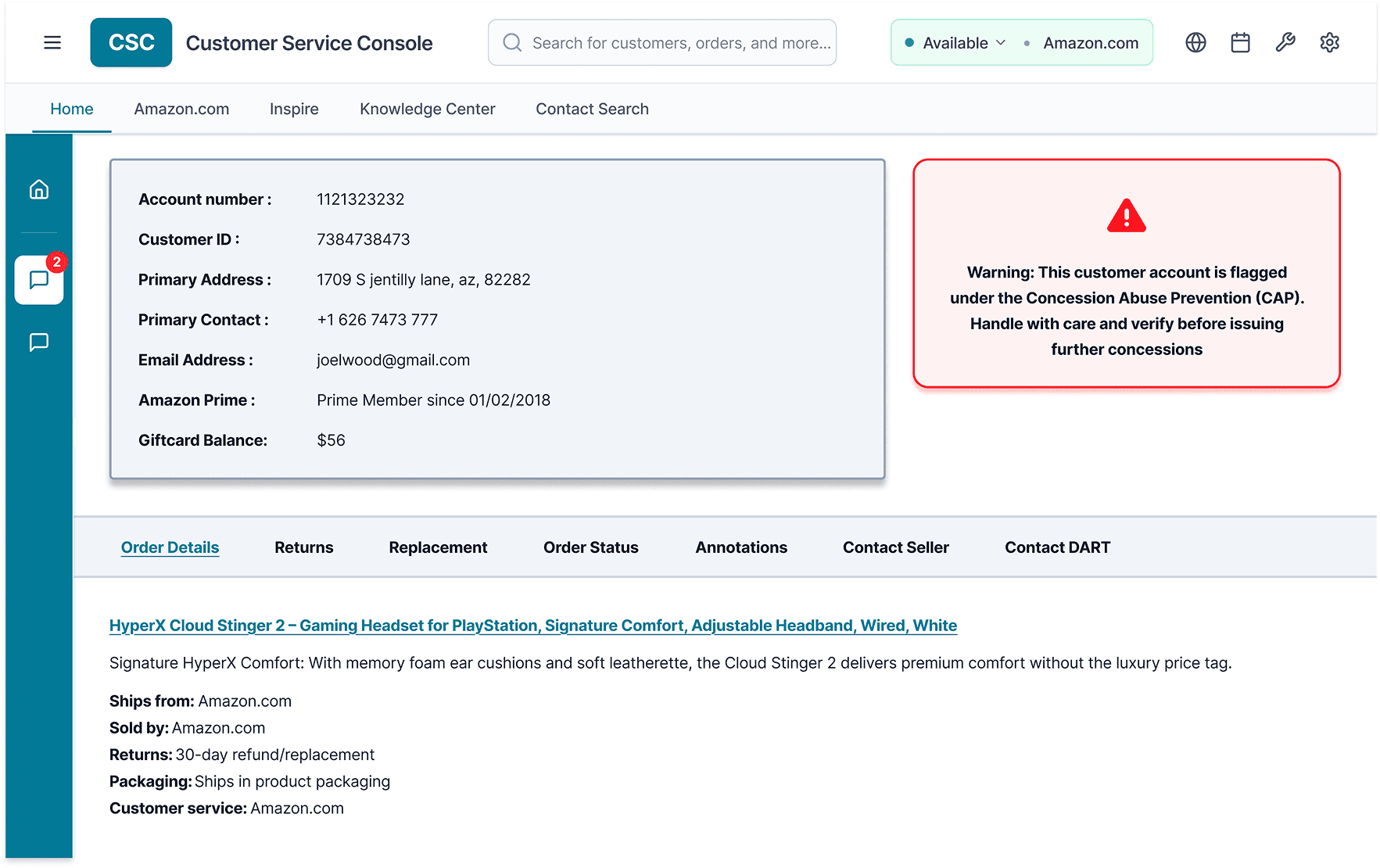
CAP Risk Surfaced at Decision Moments
Problem:
Agents missed critical risk indicators when they appeared too late or outside the main workflow.
Decision:
Displayed CAP warnings prominently alongside account context during concession-related actions.
Why it worked:
Positioned risk as a guardrail at the exact moment decisions were made.
Outcome:
Improved compliance behavior and reduced incorrect concessions.
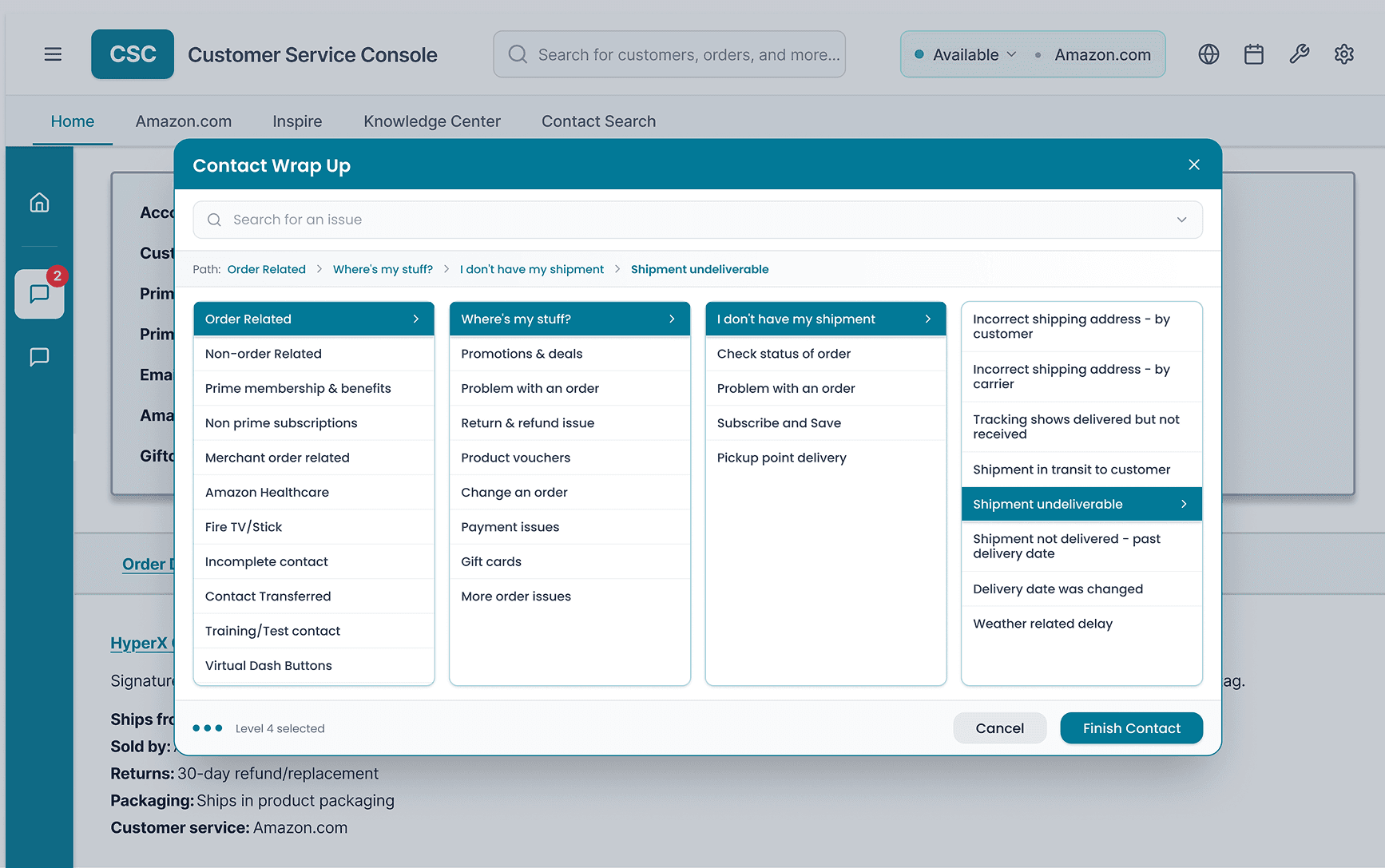
Guided Contact Wrap-Up
Problem:
Wrap-up was time-consuming and inconsistent across agents.
Decision:
Introduced a multi-level, searchable categorization flow with breadcrumbs.
Why it worked:
Supported fast selection for experienced agents while reducing misclassification.
Outcome:
Faster wrap-up and more reliable reporting.
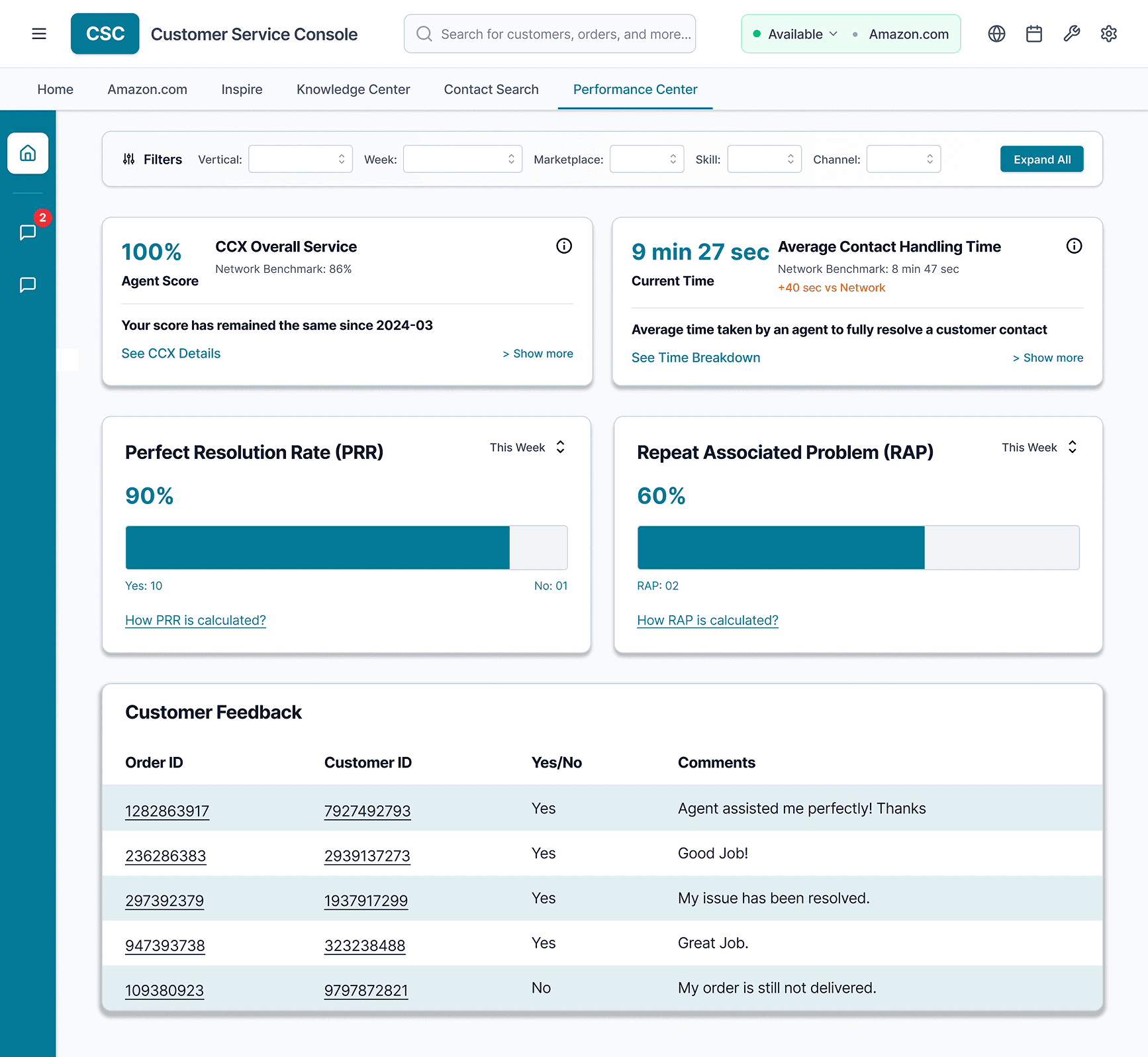
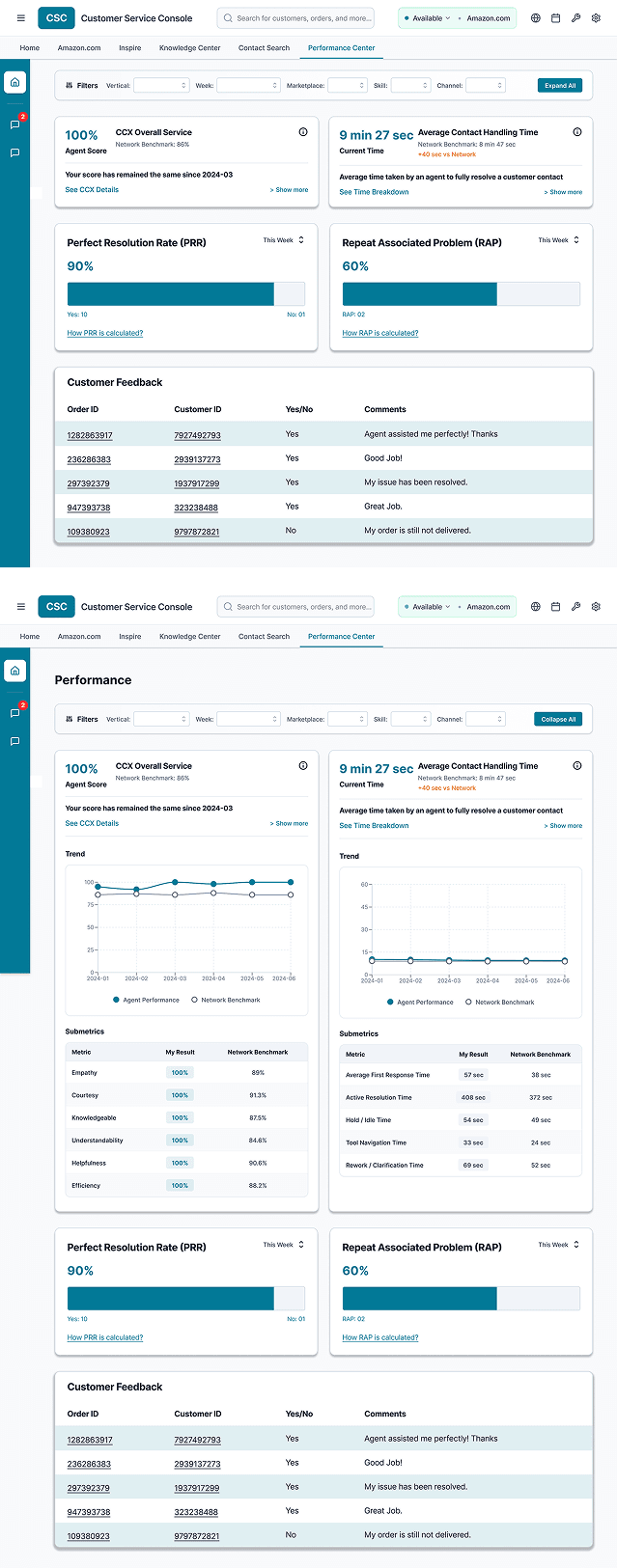
Performance Center for Actionable Feedback
Problem:
Agents could see performance metrics but lacked clarity on how to improve.
Decision:
Combined benchmarks with sub-metrics to show which behaviors impacted outcomes.
Why it worked:
Enabled agents and leads to identify coaching and improvement opportunities quickly.
Outcome:
Contributed to sustained improvements in AHT and quality scores.
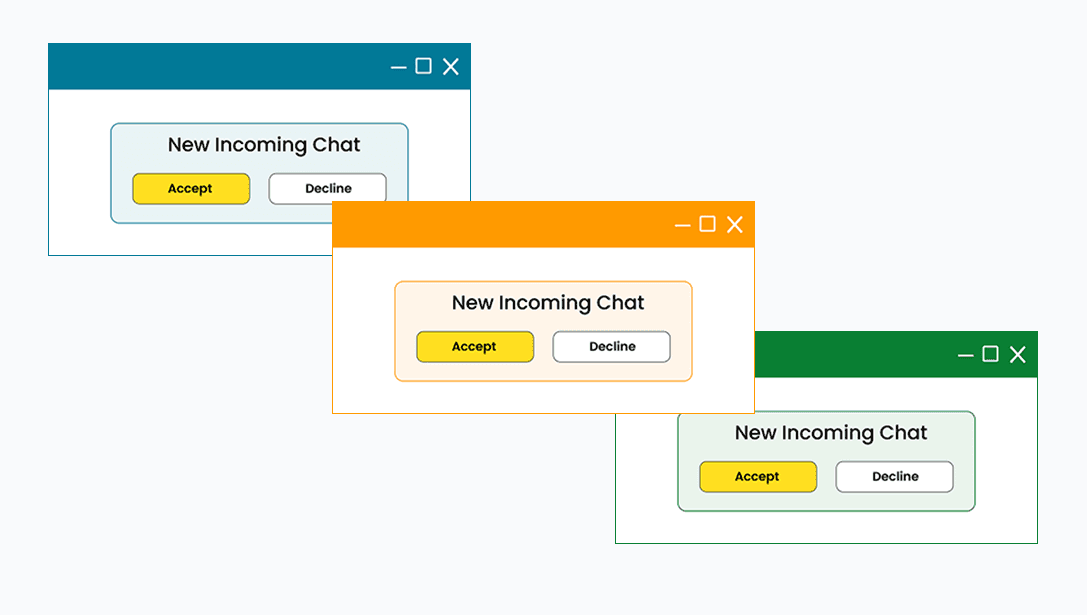
Multi-Chat Enablement
Problem:
Single-chat limitation restricted throughput and increased customer wait times.
Decision:
Designed clear incoming chat states and predictable controls for handling multiple conversations.
Why it worked:
Allowed agents to manage concurrency without losing context or accuracy.
Outcome:
Enabled up to 3 simultaneous chats per agent, reducing response times by 40%.
Results
Customer impact
Faster responses
Fewer repeated contacts
Agent impact
Reduced cognitive load
Increased confidence in handling concurrent chats
Business impact
40% reduction in response time
20% reduction in handling time
Approximately $2M in annual operational savings
Reflection
This project reinforced the importance of designing for speed, clarity, and trust in high-pressure operational environments. Given additional time, I would explore deeper keyboard optimizations and proactive assistance to further support expert agents at scale.